Your Edges Are Not the Price of Your Beauty.
Protect your edges without giving up the hairstyles you love. Discover a simple 30-day method designed to help reduce breakage, protect your hairline, and build healthier styling habits with wigs, frontals, braids, sew-ins, ponytails and protective styles.
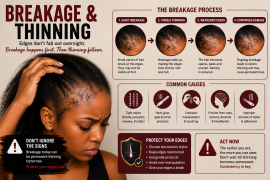
BREAKAGE & THINNING
Your edges look shorter, weaker or noticeably thinner after repeated styling.
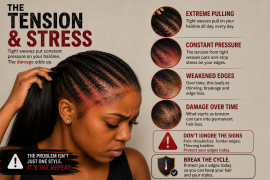
TENSION & STRESS
Braids, frontals, ponytails and installs may be putting more pressure on your hairline than you realise.
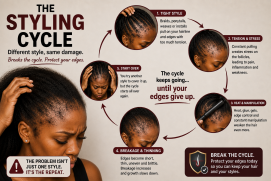
THE STYLING CYCLE
You protect thinning areas with another style — only to expose your edges to the same damaging habits again.
I Didn’t Think My Edges Would Ever Become My Problem
For a long time, I thought edge loss was something that happened to other women.
I loved my hair. I loved looking put together. I loved the feeling of a fresh install, neat braids, a sleek ponytail, or a frontal sitting exactly the way I wanted it to.
And because my hairline had always been there, I never really imagined that one day I would look at it and feel worried.
At First, I Kept Explaining It Away
At first, nothing seemed serious.
I would remove a style and notice that the little hairs around my temples looked slightly thinner. I told myself it was normal. Maybe I had been too rough during removal. Maybe I just needed more moisture. Maybe a few days of rest would fix it.
So I would apply something to my edges, tie my scarf, give myself a tiny break… and then start thinking about my next hairstyle.
If one side looked thinner, I positioned the hair differently. If my temples were showing too much, I adjusted the frontal. If a hairstyle exposed an area I didn’t like, I simply chose another style.
And if I could make it look fine in the mirror, I convinced myself everything was fine.
But the thinning didn’t happen all at once. It happened quietly.
A little breakage here. A weaker-looking area there. One temple beginning to look different from the other. Tiny hairs that never seemed to get past the same fragile stage.
Then another install. Another removal. Another hairstyle. Another promise that I would give my edges a proper break “next time.”
Eventually, I started checking my hairline differently. I would turn my head to inspect one side, then the other. Sometimes I pulled everything away from my face and stared. Sometimes I even took pictures just so I could zoom in.
Then one morning, with nothing covering my hairline and nowhere left to hide it, I looked properly at myself in the mirror.
And one thought hit me:
“When did it get this bad?”
I Was Trying to Fix My Edges — But I Was Still Repeating the Damage
Seeing my own hairline like that affected me more than I expected. I felt embarrassed, frustrated and increasingly self-conscious about styles that exposed my temples.
So I started looking for something that would grow my edges back. I tried oils. I tried different mixtures. I bought products with words like growth, strengthening and repair written across the packaging.
Every time I started something new, I felt hopeful. Maybe this would finally be the one.
But at the same time, I was still doing many of the things that had stressed my hairline in the first place.
I would oil my edges at night, then allow another tight style to pull on them. I would tell myself I was giving them a break, then install something new before they had really had time to recover.
Sometimes I knew a hairstyle was too tight from the moment it was finished. I would feel the pulling and tell myself, “It will loosen.” And sometimes it did — but my edges had already spent those first days under unnecessary tension.
I even changed stylists, thinking maybe that was the whole problem. One would be gentler with braids, but afterwards I would choose another high-tension style. Another would install my frontal differently, but I was still repeating styles with very little recovery time between them.
I blamed glue. I blamed braids. I blamed products. At one point, I even blamed my own hair for simply being too fragile.
The confusing part was that I wasn’t doing nothing. I was applying products, moisturising, trying oils, taking occasional breaks and searching for answers.
So why did it still feel like I was going in circles?
I had been concentrating almost entirely on what I was putting ON my hairline… without paying enough attention to what I kept DOING to my hairline.
I Didn’t Need to Give Up the Hairstyles I Loved
Once I understood that, the way I cared for my edges started changing.
I began paying attention to tension instead of treating that tight, pulling feeling as the normal price of a neat hairstyle. I became more careful about where adhesives were placed, how my styles were installed and how I removed them.
I stopped treating takedown day like something to rush through. I started giving fragile areas more consideration and became more intentional about recovery time between styles.
Most importantly, edge care stopped being something I only thought about after I noticed damage. It became part of the way I chose, wore and removed my hairstyles.
I also made one decision very early: I was not going to build a routine that required me to give up every hairstyle I loved.
I still wanted my wigs. My braids. My frontals. My ponytails. I just needed to stop treating unnecessary tension, rough removal and constant manipulation as the price I had to pay to wear them.
So I became more deliberate. Before choosing a style, I started considering what my edges had recently been through. While wearing it, I paid attention to warning signs instead of ignoring discomfort. During removal, I slowed down. Between styles, I stopped treating recovery time like wasted time.
The changes were not dramatic overnight. I didn’t wake up three mornings later with a magically transformed hairline. What changed first was that I finally felt as though I had stopped fighting against myself.
I became gentler. More observant. More consistent. And gradually, I started noticing little changes — less unnecessary pulling, less panic around my hairline, and fragile areas finally being treated like fragile areas instead of being forced into every hairstyle.
Then one day, a close friend looked at me properly and said:
“Wait… your front is actually looking better. What have you been doing?”
That moment stayed with me because the change hadn’t come from finding one miracle oil or abandoning every hairstyle I loved. It came from finally understanding that recovery and protection had to work together.
I started writing down what I was learning — what made my edges feel worse, what helped me reduce unnecessary stress, how much difference recovery time made, and which styling habits I needed to change before expecting my hairline to improve.
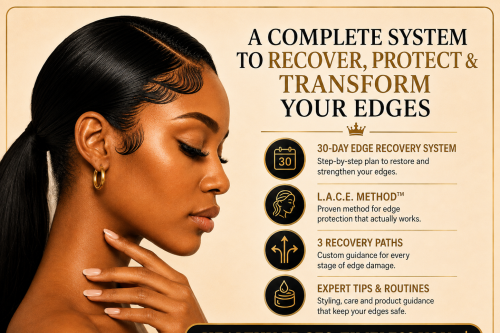
Little by little, those notes became a simple routine I could actually follow. Not a routine built around perfection, and not one that promised impossible regrowth, but a practical way to protect fragile edges, support recovery where recovery was still possible, and make better choices without giving up wigs, frontals, braids, sew-ins, ponytails and the styles I enjoyed.
Eventually, I organised everything into a 30-day recovery and protection system — the kind of step-by-step guidance I wish I had when I first stood in that mirror wondering how my edges had gotten so thin.
Because what I needed back then wasn’t another product to buy.
I needed to understand what my edges were asking me to stop doing — and what they finally needed me to start doing differently.
30-DAY RESULTS TIMELINE
What the Next 30 Days Can Look Like
DAY 1 — STOP THE CYCLE
Identify your starting point and begin reducing the habits putting unnecessary stress on your edges.
DAY 7 — FIRST POSITIVE CHANGES
By the end of the first week, your routine may already feel gentler and more controlled, with less unnecessary pulling, handling and stress on your hairline.
DAY 14 — CONSISTENCY STARTS SHOWING
Your new protection habits are becoming more natural, and fragile areas are getting more consistent care and recovery time.
DAY 30 — VISIBLE PROGRESS
Progress may be more noticeable by Day 30, depending on your starting point and whether recovery is possible — alongside stronger protection habits and a clearer edge-care routine.
What Women Are Saying So Far
Especially the part about knowing when your edges need rest. I wish someone explained it to me earlier. Very useful.
Anonymous Reader
★★★★☆
Uganda • Jul 2026
I’ve saved the 30-day section because that’s what I’m working with now.
Anonymous Reader
Currently trying the guide
Zimbabwe • Jul 2026
I was so focused on regrowth that I wasn’t paying attention to the damage I was still causing. What stayed with me was that protecting the hair you still have matters too.
Anonymous Reader
★★★☆☆
Rwanda • Aug 2026
I’m going to try this properly because the section on tight styling made me realise I’ve been doing too much to my edges.
Anonymous Reader
Planning to start this week
Zambia • Aug 2026
Started following the routine. Not doing ten different things anymore and honestly that alone has made it easier
Anonymous Reader
Currently trying the guide
Tanzania • Aug 2026
Me hiding my front with gel every single day like the problem will disappear This guide made me sit down and face what I was doing.
Anonymous Reader
★★★★☆
Cameroon • Aug 2026
I didn’t realise how much pressure I was putting on my edges until I started paying attention to the way I install and remove my styles. The guide made the whole thing feel much more manageable.
Anonymous Reader
★★★★★
Ghana • Aug 2026
The part about giving my edges recovery time made sense. I’m still early in the routine, so I can’t say much about results yet, but I’m paying more attention to tension now
Anonymous Reader
★★★☆☆
Kenya • Aug 2026
By the first week, the biggest difference for me was how much gentler I had become with my hairline. I’m still following the routine, but I’m definitely more conscious of what my edges can handle.
Anonymous Reader
★★★★☆
Nigeria • Aug 2026
The styling section got my attention because I wear protective styles almost all the time. I’m starting the 30-day routine this week and I want to see how my edges respond.
Anonymous Reader
Starting the 30-day routine
South Africa • Aug 2026
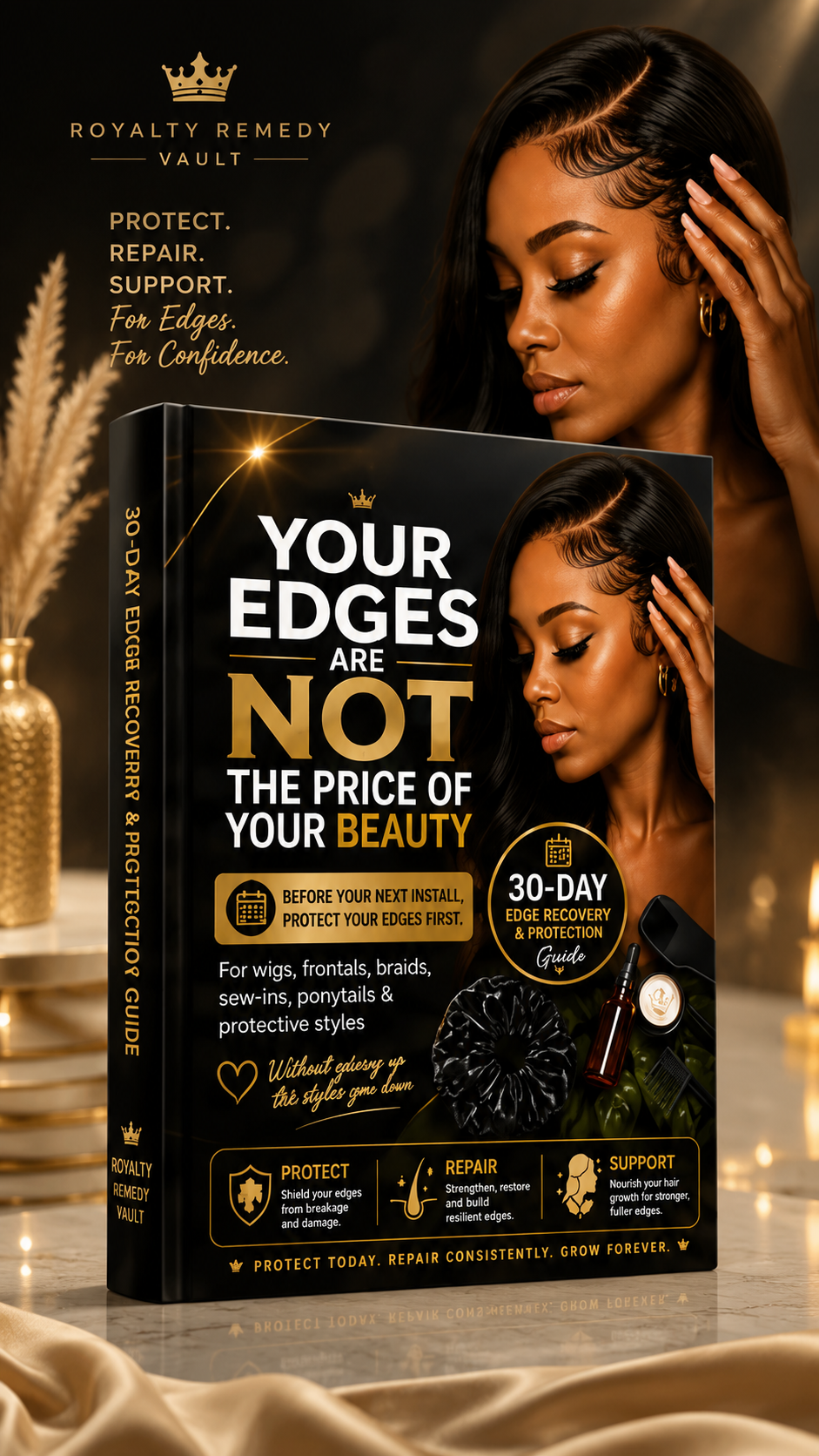
Meet Your 30-Day Edge Recovery & Protection Guide
Your Edges Are Not the Price of Your Beauty
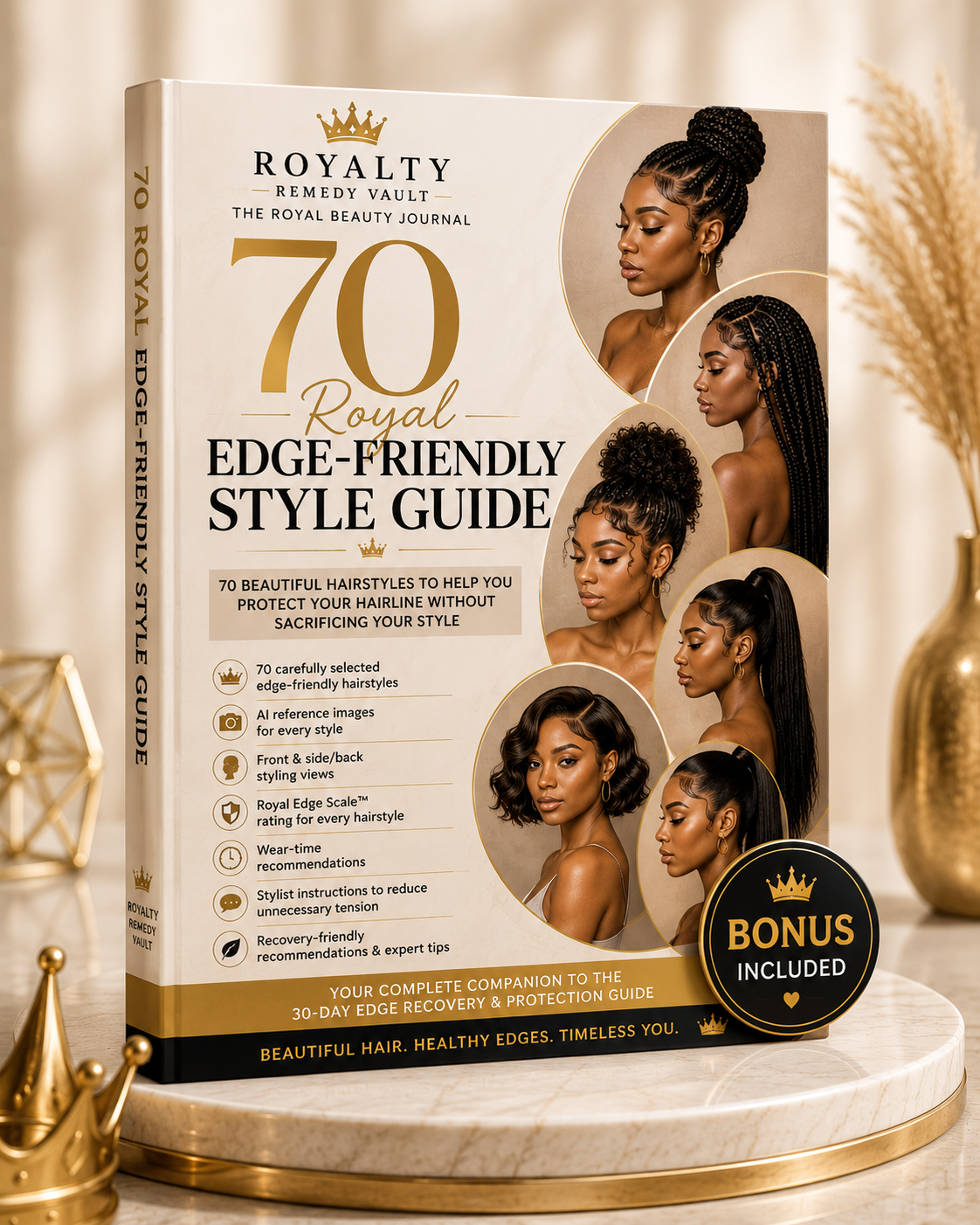
BONUS: 70 Royal Edge-Friendly Style Guide
Included FREE With Your 30-Day Edge Recovery & Protection Guide
Standalone Value: ₦5,000 — Yours FREE With the Guide
Protecting your edges doesn’t mean running out of beautiful hairstyles. This bonus gives you 70 carefully selected looks across 7 collections, so you can keep switching up your style while making more thoughtful choices around your hairline.
70 Edge-Friendly Hairstyles
Beautiful styling ideas selected with edge protection in mind, organised across 7 carefully curated collections.
Visual Guidance for Every Style
Each hairstyle includes 2 reference images to help you clearly understand the look before recreating it.
Your Complete Edge Recovery Package
MAIN GUIDE
₦9,950 Value
30-Day Edge Recovery & Protection Guide
Complete 30-Day Recovery & Protection System
FREE BONUS
₦5,000 Value
70 Royal Edge-Friendly Style Guide
70 Styles Across 7 Collections
YOUR OFFER TODAY
Launch Price: ₦7,500 / $7.97
Total Value: ₦14,950
Regular Price: ₦9,950
₦7,500 / $7.97
First 20 Buyers Only
30-Day Action Guarantee
Try the system for 30 days. Go through the guide, identify your recovery path, follow the recommended routine, reduce the habits putting unnecessary stress on your hairline, and give the system a genuine chance to work.
If You Don’t Feel It Helped
If, after genuinely following the guide for 30 days, you feel it has not helped you make meaningful progress in the way you care for, protect, and support the recovery of your edges, you may request a refund.
At This Point, You Have Two Choices
You can leave things exactly as they are — or spend the next 30 days giving your edges a more intentional kind of care.
OPTION 1 — CLOSE THIS PAGE
Before You Go, Remember These Three Things
You don’t need another miracle promise. You need a realistic plan, a genuine chance to follow it, and a reason to start before more unnecessary damage is done.